We Have Never Been Modern (And Neither Was Your BIM Tool)
Part 3 of the Design for AI-first User Experience series. Architects have always designed across tools from different eras, from the pencil to the BIM model. This essay looks at where AI agents fit: the newest tool on the bench, and the first that can make its own decisions, yet still one more thing in service of the work.
.png)
Mike's Been Here
Annie walks across the dimly lit office kitchen, grabs a mug and makes herself coffee. As she glances toward the studio, screensavers illuminate. First again, she thinks. The lights come on as she steps through into the studio. Across the floor, several of the monitors carry marker traces from the day before.
Mike's been here.
She can see it: Mike seated for an impromptu crit at the desk of one of the architects, marker in hand, sketching on the monitor showing drawings and 3D models. As if it were tracing paper. Talking through it, then moving to someone else's desk. The marks stayed on the monitor.
Mike is a fictional name of a real architect. The scene was described during a Motif design partner research session.
We Were Always Modern
The marker, the monitor and the 3D digital model are tools from three different ages, brought together with the same gesture. The modernist story is that each new tool replaces the last. Bruno Latour spent decades arguing the opposite:
I may use an electric drill, but I also use a hammer. The former is thirty-five years old, the latter hundreds of thousands. Will you see me as a DIY expert “of contrasts” because I mix up gestures from different times? Would I be an ethnographic curiosity? On the contrary: show me an activity that is homogeneous from the point of view of modern time . . . . As Péguy's Clio said . . . “we are exchangers and brewers of time.” (Latour 1993, 75)
Latour delivers this with a glint of mischief, daring the reader to find a single activity that doesn't already mix gestures from different times.
The hammer joined the drill in Latour's toolbox the way Mike's marker joined the 3D model on the monitor. The tools coexisted, did not replace; the earlier tool joined the network alongside the newer one where each tool does what only it can do.
Edith Ackermann, the developmental psychologist who continued Piaget's line of inquiry, once described an observation to me about children's conception of time. Young children do not sort tools by age, she said. A marker and a computer are equally old to them; both predate the child. The modernist sorting of tools into historical strata is learned, not given. The child's perception is closer to the practitioner's condition than the modernist story declares.
Mike is not a curiosity, but a piece of evidence in a longer record.
Another Kind of Hybrid Object
The studio has always taken on new tools. Some required new partnerships, some required new methodology, some required new practitioners holding new kinds of authority. None changed the structural fact that the practitioners' attention was on the work and the tools were in service.
AI agents are different, and the difference is specific. An agent, a system that dynamically directs its own processes within bounded scope, is distinct from prior tools whose steps were predefined. Rhino executes when called. Revit updates when parameters change. Both do what they are told. An agent decides what to do within the scope it was given. The scope is bounded; the decision-making within the scope is not predefined.
This raises a question the studio has not had to answer before. The studio has always coexisted with agency — junior architects, partners, consultants, contractors, clients, all making their own decisions within their own scope. What it has not coexisted with is agency that comes without formation, without accountability, without stamp authority, without the standing that human practitioners build through years of practice. What does coexistence look like with that kind of agency in the network?
The question lives in 2026. Agentic workflows in two, five, even ten years will look dramatically different from what they look like today, and the answer will look different too. Whether AI represents a categorical break, or a hybrid in the same lineage as the tools that came before, is a question for another time. This essay outlines the continuity that holds across eras.
Not All Drivers Are Mechanics
Sherry Turkle described two cultures of transparency. The early 1980s personal-computer culture, she has written, organized itself around the pleasure of understanding a complex system down to its simplest level (Turkle 1984, 8). Users prized a direct mechanical relationship with the machine, applying the same ethic that surrounded the early automobile, where the driver was expected to understand the engine. Transparent, in this culture, meant the workings were legible all the way down. By the mid-1990s, when something was called transparent, it meant one could immediately make it work, not that they knew how it worked (Turkle 1995). One culture wanted to see down to the parts; the other wanted a working surface and trusted the layers below to behave.
The shift in the meaning of transparency was a shift in what kind of understanding the user expected a tool to support.
Frank Gehry sat inside the earlier culture and refused the later one. Dennis Shelden, who served as Director of Computing at Gehry Partners and wrote his MIT doctoral thesis on the firm's digital practice under William J. Mitchell, documented the refusal: Gehry “remains skeptical of computing as a tool for design. He speaks with a certain degree of pride in his inability to operate a computer, and suggests that the quality of the digital image is dangerous and subversive to the designer's eye” (Shelden 2002, 23).
The refusal was not neglect. Gehry built one of the most computationally demanding architectural practices of the late twentieth century. None of the buildings would be imaginable, or buildable, without the digital practice the firm built around CATIA. The architect who refused to turn on the computer was the same architect who restructured his firm's relationship to digital fabrication.
Shelden documented the architecture of the refusal. Gehry's design process privileged physical models as objects whose materials and craft anticipated the building. When the firm needed to convey a double-curved surface to a contractor and conventional documentation could not carry it, Gehry turned to Jim Glymph, who brought deep aerospace-industry experience and computing fluency the practice did not yet have. Glymph turned to CATIA, aerospace software, which entered the practice not as a design tool but as a translation tool: the bridge between Gehry's models and the fabricators' machines.
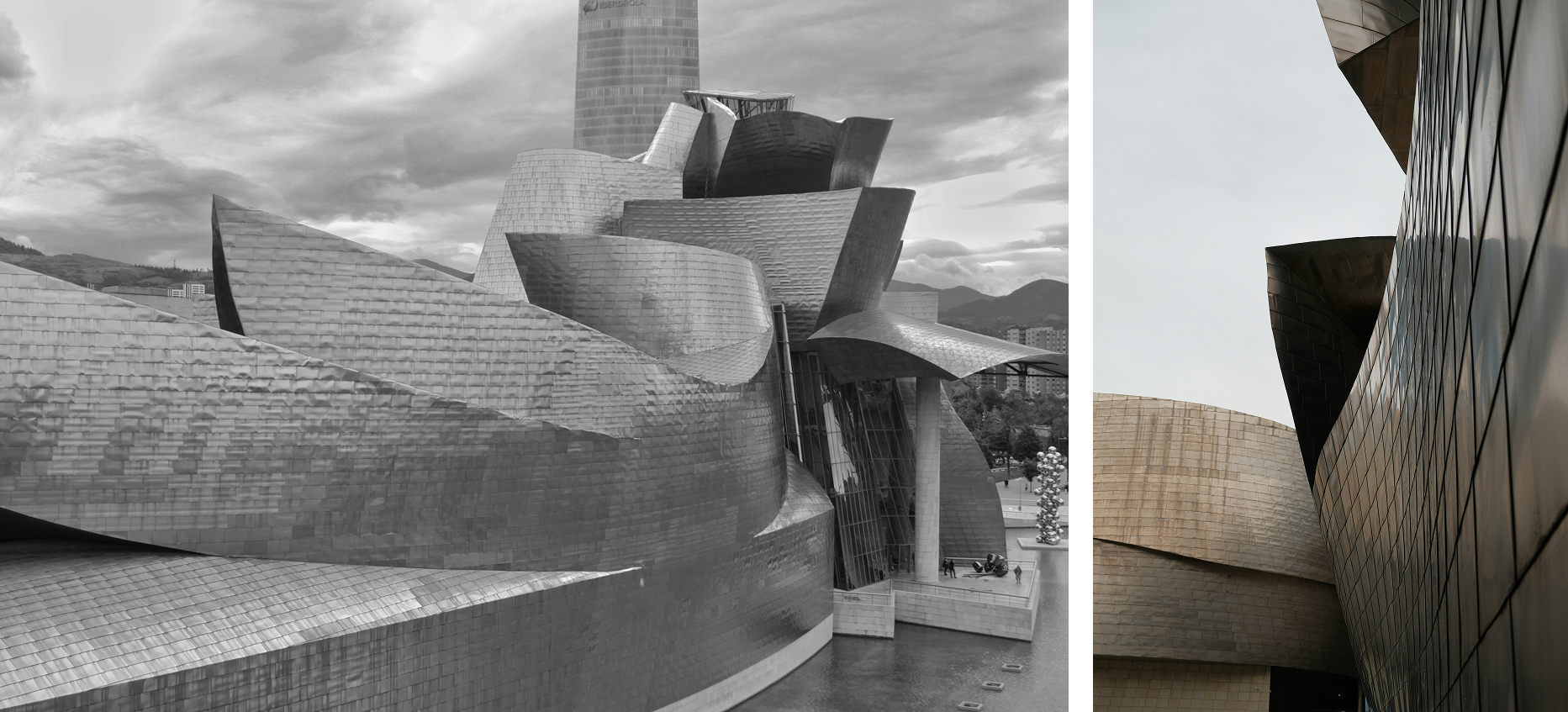
Two practitioners, two registers of expertise. Gehry: the model in his hands, the material in front of him, the design intelligible through direct contact. Glymph: the firm's technological architecture, the digital practice that scaled the work, the partnership with Dassault that produced Gehry Technologies in 2002. Each authoritative in their own register, and neither operating below the other.
This is what the hybrid object Latour described looks like as a working firm. Two seniors, two complementary forms of authority and expertise, one practice.
The question for AI in architecture is not whether it ruptures practice. It is what hybrids the technology produces, and where in the studio different forms of authority now sit.
Been There, Done That
In his essay “Algorithmic Workflows in Associative Modeling,” Shane Burger, then a member of Grimshaw's Computational Design Unit, describes a story from 2008 at Grimshaw, London. He was seated at his desk with two monitors showing an associative model in Generative Components: a geometric control jig, parameters mapped to control sliders, square footages and program distributions updating dynamically. Sir Nicholas Grimshaw walked over and Shane explained what was on screen. Unimpressed, Nick turned the discussion to the design itself, not the technology. The associative geometry, in Shane's words, “was a direct manifestation of the design methodology Grimshaw Architects was founded upon, simply in digital form. It was natural and intuitive” (Burger 2012, 133).
What was groundbreaking as automation was, to Grimshaw, a self-evident expansion of the systems thinking the firm had practiced for thirty years.
The scene is the inverse of Gehry's. CATIA arrived at Gehry's firm as the answer to a transmission problem he had not yet been able to solve. At Grimshaw, Generative Components arrived as a tool whose underlying logic had been practiced for thirty years. The Waterloo International Terminal, completed in 1993, had required associative thinking long before the software existed: its geometry developed not from explicit measurements but from “a collection of implicit rules and relationships between parts” (Burger 2012, 133).
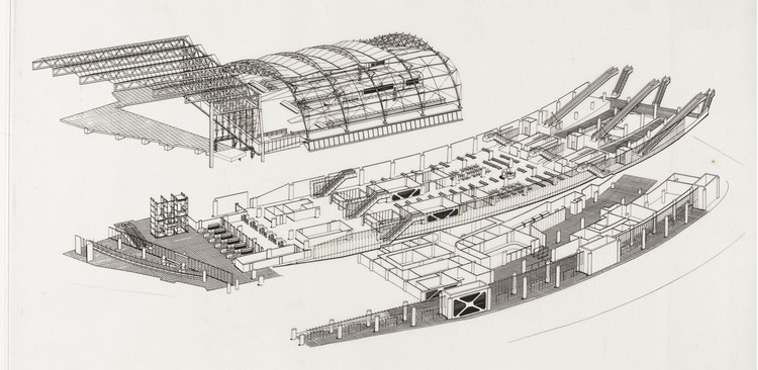
London, ca. 1988–1993. Given by Grimshaw to © Victoria and Albert Museum, London. 5 year permission.
Two cases, two outcomes. A tool can rupture practice or continue it, depending on whether the practice was already shape-fitted for what the tool offered. Gehry encountered CATIA as a question the firm had not yet asked. Grimshaw encountered Generative Components as something familiar, a way of working for his entire career.
Fit-to-Task, Not X-First
Vendor rhetoric runs in firsts, the most recent one being AI-first. Before that, cloud-first, mobile-first. Each becomes the principle around which practices are assumed to reorganize to innovate and survive.
Architects, in many cases, use first differently. First principles: what are we solving, for who, where and why. The vendor's first is hierarchical; the practitioner's first is investigative.
Half of design is in how the problem is framed. Donald Schön named this distinction in 1983 as problem-setting versus problem-solving. Technical rationality treats the problem as given and optimizes a solution. Reflective practice treats the problem itself as the thing to be constructed (Schön 1983, 40, 54). The same instinct reaches software readers through Clayton Christensen's jobs-to-be-done framing — the architect doesn't buy a tool, the architect hires one to do a job (Christensen et al. 2016).
X-first inverts the move. It treats the tool as the organizing principle and the work as something to be reshaped around it. Latour's term for this is sorting: separating the new from the network it lives inside, treating it as the center of the field rather than one node among many.
Adoption costs make X-first easier to sell. Radu Lupu, formerly at Foster + Partners, observed during an earlier Motif research session that tools take off in firms when there is nothing to teach. In his words: “Do you teach people how to use Facebook or Twitter? You don't. Off they go from the moment they sign up! I don't need to run training programs. Training for legacy software takes months!” A tool that demands long training tends to become the organizing principle of the firms that adopt it, because the firms have to justify the investment. A tool that is frictionless slots into existing practice without restructuring it, and gets evaluated on whether it does the job, because the practitioner has not paid an upfront cost that biases the evaluation.
Mike was not optimizing for the marker, Grimshaw was not optimizing for Generative Components, nor was Gehry optimizing for CATIA. Each reached for what did the job, and each evaluated a tool by where it fit. Fit-to-task settles a tool among tools. The studio holds the network together: different practitioners, different tools, different registers.
Master, Apprentice, and More
The architectural studio runs on coexistence between practitioners. The canonical mode is one mode, and it is not the only one. This essay offers three.
The first is the archetypical “Mike”, the relationship between senior and junior architects. The senior carries attention across multiple projects; the junior pursues depth inside one. A senior like Mike provides feedback on multiple projects in a week, sometimes in formal design crits and sometimes in impromptu sessions. The architects work through the feedback afterward.
The second is Gehry and Glymph: two seniors in peer partnership, each authoritative in their own register. Gehry's authority sat in the design, Glymph's in the firm's technological innovation and the partnership with Dassault. It is this peer mode that made Gehry Technologies possible in 2002, with Glymph and Gehry founding it together.
The third is Sir Nicholas Grimshaw and Shane Burger in 2008. Shane brought associative design into the firm, at the cutting edge of where the field then was. Sir Grimshaw recognized his own methodology in this new tooling. This is not master/apprentice. Sir Grimshaw recognized his practice in the new tool while Shane brought the method in.
What these three modes share is not the relation between practitioners. It is what the practitioners attend to. Mike attended to what emerged in the seeing and the doing: a line he draws that follows a line that already “lives” in the model onto which he draws. Gehry attended to the building as it took shape in the model and the material in front of him. Grimshaw attended to the methodology, and recognized it on Shane's parametric model. The tools were in service of the seeing and the doing. None of the practitioners were attending to the tool itself.
This is what allows a studio to absorb new tools without rupture: the studio's attention is on the design, on the seeing and the doing of the work, not on the tool that mediates it. Tools enter, find their fit, and are evaluated by whether they serve the work. The marker, Rhino, Revit, Grasshopper — all hired into ongoing practice. While some of these tools organize the practice around themselves, the practitioners' attention is elsewhere: on the buildings to be designed.
The marker line on the monitor works partly because Mike and the architects are collocated. The desk crit is the medium of architectural learning, not peripheral to it. The studio holds what no individual practitioner holds alone, and what Mike knows cannot be sent in an email: the transmission requires the room, the model, the marker, and the person who watches the mark land.
Architects are formed in the studio because the studio teaches them what to attend to: the design problem. Tools come and go. Master/apprentice is one carrier of this attention. Peer partnership is another. Senior recognition of a new method as the firm's own is a third. All three transmit attention across the practitioners who pass through the studio, and through them across the generations of practice.
My Agent Will Call Your Agent
It is mid 2026. One of the practitioners may already be an agent.
William J. Mitchell saw this coming, in stages. e-topia (1999) argued that digital networks and built environments were merging into a single field, where buildings and cities would behave as responsive systems rather than static containers. Me++ (2003) extended the argument inward: the user becomes a node in the same network, with tools that anticipate rather than wait. The late lectures sketched collaborators that participated. The lineage is real, the trajectory is honest, and the last step is where it bends. Mitchell's collaborator was still a participant in a workflow the human structured; the agent in 2026 is not.
Mario Carpo's The Second Digital Turn (2017) named a different break. The first turn, the parametric-scripting era of the 1990s, was rule-based: the designer wrote the rules and the computer executed them. The second is data-driven: the computer searches across vast option spaces and finds rather than computes (Carpo 2017, loc. 1321). The agentic shift is downstream of Carpo's, not the same shift, and it should not borrow his authority for a move he did not make. What his break does establish is that the digital turn is not one continuous slope. The categories that organized practice before — tool, assistant, even collaborator — were not built for participants whose internal steps are not legible to the practitioner who set the scope.
Antoine Picon's Digital Culture in Architecture (2010) is the reminder that the studio Mike walks through has already been restructured. The prior digital turn reshaped the architect's relationship to material, to the firm, to the drawing. The studio that meets agents in 2026 is not the studio that met BIM in 2002. Agents arrive into a configuration that has already been re-sorted once, and the sorting was not neutral.
Consider a hospital project. The architect is in the meeting because the work needs accumulated experience: the nurse needing sightlines from the corridor, the surgeon doing the morning walks, the patient room at six in the morning. Agents in this room do work the architect alone could not muster: synthesizing the precedent set, surfacing the code constraints, flagging the conflicts across the consultants' models. The architect contributes what the agents cannot have: the patient who walked from bed to window after the last project's surgery wing opened, the nurse who said the sightline from the new station was wrong before anyone measured it. Agents have training data. Architects accumulate knowledge, experience and insights.
Agents superpower what the architect has access to; the architect shapes what the agents can attend to. The hospital scene is an illustration of one configuration among many that the next several years of practice may surface.
These discussions are written in mid 2026. The discipline-scale questions — what happens to firms, to credentialing, when accumulated experience is the part that doesn't transfer — merit further exploration. So does the system-of-agents question, and what changes when the practitioner is coordinating not one but a network of agents. The configuration question, however, holds: who is in the room and why, what they bring, what holds across eras.
Mike's Still Here
On the Acela to Boston for a client meeting, with three and a half hours to go, Mike has the tablet on the tray table, the phone next to it.
He starts sketching on his tablet. The same gestures as marker on monitor. The tech is new; there is nothing to learn.
From New York, Annie is in the canvas with him. She has dropped in two photographs of the physical study model the team built and a note about the entry sequence the client asked about last time. Mike taps the agent — what was the question from the last client meeting? It surfaces and summarizes the thread and the list of action points. That's what he was looking for.
He drops one of the study model images into the canvas and creates a 3D model. He initiates a one-click render using the project's geo location as context. The first pass comes back too clean. He requests trees, afternoon shadow, pull back some of the foreground vegetation. The second pass is closer and he saves it as a style for the rest of the renders. He generates different views; he doesn't think about what the agents in the rendering pipeline do between his requests and the output. He will when the work calls for it. Annie flags one of the views — the south elevation reads better than the others for tomorrow. Mike keeps it.
Four tools, one of them an agent, and one train ride. This is the architect's relation to any tool: they are not optimizing for the pencil, the app, the canvas, or the rendering engine, but preparing for the client meeting. The tools are in service.
References
Burger, Shane M. “Algorithmic Workflows in Associative Modeling.” In Digital Workflows in Architecture: Design — Assembly — Industry, edited by Scott Marble, 132–139. Basel: Birkhäuser, 2012.
Carpo, Mario. The Second Digital Turn: Design Beyond Intelligence. Cambridge, MA: MIT Press, 2017. Kindle edition.
Christensen, Clayton M., Taddy Hall, Karen Dillon, and David S. Duncan. Competing Against Luck: The Story of Innovation and Customer Choice. HarperBusiness, 2016.
Latour, Bruno. We Have Never Been Modern. Translated by Catherine Porter. Harvard University Press, 1993.
Mitchell, William J. e-topia: Urban Life, Jim — But Not As We Know It. MIT Press, 1999.
Mitchell, William J. Me++: The Cyborg Self and the Networked City. MIT Press, 2003.
Picon, Antoine. Digital Culture in Architecture: An Introduction for the Design Professions. Birkhäuser, 2010.
Schön, Donald A. The Reflective Practitioner: How Professionals Think in Action. Basic Books, 1983.
Shelden, Dennis R. Digital Surface Representation and the Constructibility of Gehry's Architecture. PhD dissertation, MIT School of Architecture and Planning, 2002.
Turkle, Sherry. The Second Self: Computers and the Human Spirit. MIT Press, 1984. Twentieth anniversary edition, 2005.
Turkle, Sherry. Life on the Screen: Identity in the Age of the Internet. Simon & Schuster, 1995.
Lira Nikolovska is a trained architect and the former VP Design at Motif Systems working at the intersection of spatial intelligence and AI-first design tools. She comes from a family of architects — eight at last count — and a structural engineer father. Among pens, color markers, and wooden blocks, one of her first design tools was a halved potato. One summer her parents and their friends were working on a competition for a memorial site in Bosnia. Her mum called her out from under the drafting tables — Lira's favorite place — and handed her a potato cut in half and carved into a tree stamp. They stamped an entire forest onto a meters-long site plan, tree by tree, in black ink. Cut potatoes are tools, too. This essay, third in a series, may not reflect opinions of Motif Systems.