Opening the Motif API
Own your data, own your intelligence. Introducing the Motif API.
Every firm has its own way of working: standards, details, workflows, analysis methods, and what the team has learned from years of projects. That’s a firm’s edge, and much of it is already captured as data in templates, detail libraries, scripts, and past project models.
With AI agents, firms can encode that knowledge and apply it on every project. A team could hand an agent a project’s requirements and get back a first draft built the way the firm would actually build it. But an agent can only work your firm’s way if it can understand your firm’s data. In a closed system, your AI is limited to whatever the vendor chose to expose.
That’s why we built the Motif platform to be open at its core. Owning your data is how you own your intelligence.
The first step: the Motif API
Motif Design, the app we launched in September, runs on that platform. Today we’re giving you direct access to it with the Motif API.
Until now, “open” in Motif meant moving data in and out of the app through file imports and connectors. With the API, you can now work with your data directly, from your own applications, scripts, and agents, through the same services the Motif app uses.
With the API, you can:
- Connect securely. Authenticate with your own credentials and reach your project data.
- Read and write directly. Query and edit your data without going through a file export.
- Create your own building elements. You can create elements via the API and also add your own custom data to existing elements. Soon you’ll be able to give these elements their own actions too, like a custom structural member or a rail component.
Together, this means you can connect your own data sources to Motif and build applications that work with your models. A few examples of what you can build:
- Connect to your firms content and standards library with the elements in your Motif models.
- Connect to your environmental building performance and structural analysis tools
- Send quantities to your cost or embodied carbon tool and bring the numbers back into the model.
- Review projects and models in Motif, create new layouts in Motif
Buro Happold's engineering data, on its own terms
Buro Happold has more than 30 disciplines under one roof. Years ago it built BHoM, the open-source Buildings and Habitats Object Model, to give them a shared language for engineering data, and then released it to the whole industry. Today BHoM spans more than 1,200 object models, with adapters to over 30 applications.
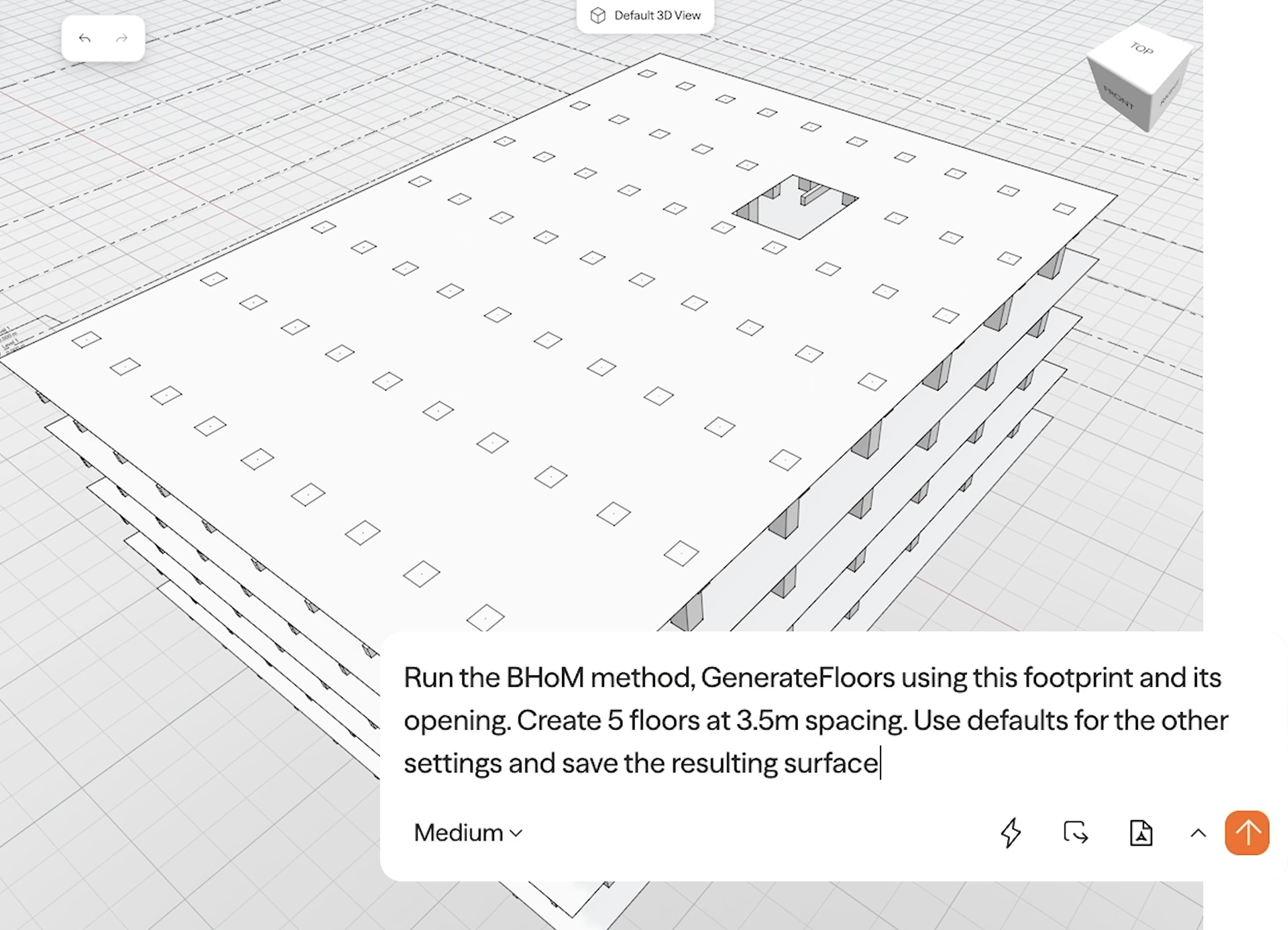
Working with Buro Happold’s computational engineering team, we brought BHoM into Motif and built a structural application on it. Its objects (bars, nodes, section properties, materials) live in Motif exactly as Buro Happold defines them, with their own schema and their own behaviors. They weren’t translated into Motif’s schema to get there.
That matters because building design is a team sport. Every discipline brings its own tools and data models. Sharing building data across them usually means converting one into another, and some of the meaning gets lost along the way.
“Our industry is multi-party. It’s full of data. But each party has its own data and its own way to represent it,” says Alain Waha, CTO at Buro Happold. “That only works if from the beginning your system is collaborative and anticipates that yet another party is going to come in.”
Now BHoM’s engineering logic sits inside a live, browser-based model, alongside Motif’s multiplayer editing, version history and security. Buro Happold’s toolchain stays its source of truth, and the people it works with can see and build on that data without leaving the shared model.
“When you start thinking about our relationship with Motif, what that will allow us to do is integrate our knowledge and our workflows in a better way,” says Marc Barone of Buro Happold, “to deliver better solutions for our clients.”
Buro Happold brought its own schema into Motif. The API opens that same foundation to every firm.
Under the hood
For those who want the details, here’s how the platform is built.
Data model. Motif uses an entity component system. Elements are composed of components rather than defined as fixed classes in an inheritance hierarchy. You can add components to existing elements or register new types in the type registry. Type definitions are published, so Motif's own schema can be extended and new schemas can sit alongside it.
Shared core. We built the data model, the parametric change engine, and the agent system together. There's no separate plugin layer.
Concurrency. Motif uses optimistic rather than pessimistic locking. Multiple clients (people, agents, your applications) can edit the same model at the same time. Changes are reconciled and propagated instead of checked out. Regeneration runs in parallel, locally and in the cloud.
History. Each model has it’s own immutable history. Any change a user or an agent makes is traceable and becomes part of the record, just like source control in software development.
API. It's REST for Projects, Models and Users. Motif uses gRPC for entities and components inside models. The schema is open and users can register their own components.
What's next
The API is the first of several ways into the platform, and a formal SDK arrives early next year. From there, we’re building toward a platform for making your practice agent-native: your standards, workflows, and project knowledge encoded in agents of your own, running on data you own.
That’s what open is for. Firms are going to run on their own intelligence, and that intelligence should belong to them. Our commitment to openness is written down in our Bill of Rights: your data is yours, open standards are the default, and you stay because Motif delivers value, not because you’re locked in.
To learn more about the Motif API and request access, visit the Motif developers page.

Matt is the VP Strategy and Industry Solutions at Motif and spent over two decades at Autodesk, contributing significantly to the development of Revit Architecture and Revit Structure. He also led the team responsible for Dynamo, a computational design tool widely adopted in the architecture, engineering, and construction (AEC) industry.