Everything in Its Right Place
No design tool does everything, and nobody makes a building alone. Amar Hanspal on why Motif would rather be a planet than the sun, and what real collaboration looks like when some of the team isn't human.
Yesterday's post was about the machine: agent-native BIM and the platform it requires. Today is about where that platform sits in your world. Because no design tool is the whole of the work, and the people who make buildings never work alone. When we introduced Motif Design, we made three promises: agent-native, open, collaborative. This post is about the second and third. Or, put another way, it's about putting everything in its right place.
Open
Every piece of software has a philosophy about its place in the world, whether it admits it or not. A lot of tools want to be the sun: the center everything orbits, the system you route your whole practice through, the thing that quietly resents any tool it didn't build. We don't want to be the sun. We want to be a planet, a good citizen in a solar system full of other tools, pulling our weight and playing well with everything around us.
That's not modesty. It's a response to how AEC professionals actually work. A model can tell you the what: this wall, this room, this dimension. It rarely tells you the why or the how. The cost tradeoff that killed one option. The client conversation that reshaped a floor. The code interpretation that settled a debate. All of that reasoning, the actual work, happens somewhere else, in the tools, documents, and conversations that never touch the geometry. And it always will. If all you can see is the geometry, you're reading the last page of a story and guessing at the plot.
If you've been around design tools long enough, you've seen a version of this flip before. The early CAD systems made you name the command first, then pick the thing you wanted to act on. Verb, then noun. Eventually it reversed: you select the object first, then decide what to do with it. Noun, then verb. It sounds small. It wasn't. It moved the center of attention off the tool's menus and onto the thing you were actually working on. We're making the same reversal one level up: from the application at the center to the work at the center.
Our co-founder and CTO Brian has a phrase for the alternative: data at the center, not application at the center. Put the work at the center of the process, not the software.
In practice, that means interoperability is a first principle, not a feature we bolt on later. Plugins connect to the editors you already use, streaming live from Revit and Rhino without exporting or converting. Connectors reach project data wherever it lives: in Slack and Outlook, on your Box drive, in ACC or Procore, in PDFs, Office docs, and spreadsheets, the messy reality of a real project.
And the openness runs all the way down to the data itself: no closed formats, no data held hostage, no walled garden to move into. Over time, you will be able to add your own object types, properties, and behaviors to our data model as your firm needs them, and they stay yours. The model becomes one powerful view onto the work, not the box everything has to be locked inside.
There's a new reason all of this matters now. Agents raise the stakes on openness, because an agent can only reason with what it can reach. The brief in a PDF, the requirement buried in an email thread, the product data on a supplier's site: every piece of context you connect makes every agent on the project smarter. Closed systems don't just inconvenience people anymore. They starve the intelligence.
Collaborative
Real projects have never been one person, and soon they won't be only people. So underneath everything sits the machinery that lets a whole team work on the same building at once without chaos.
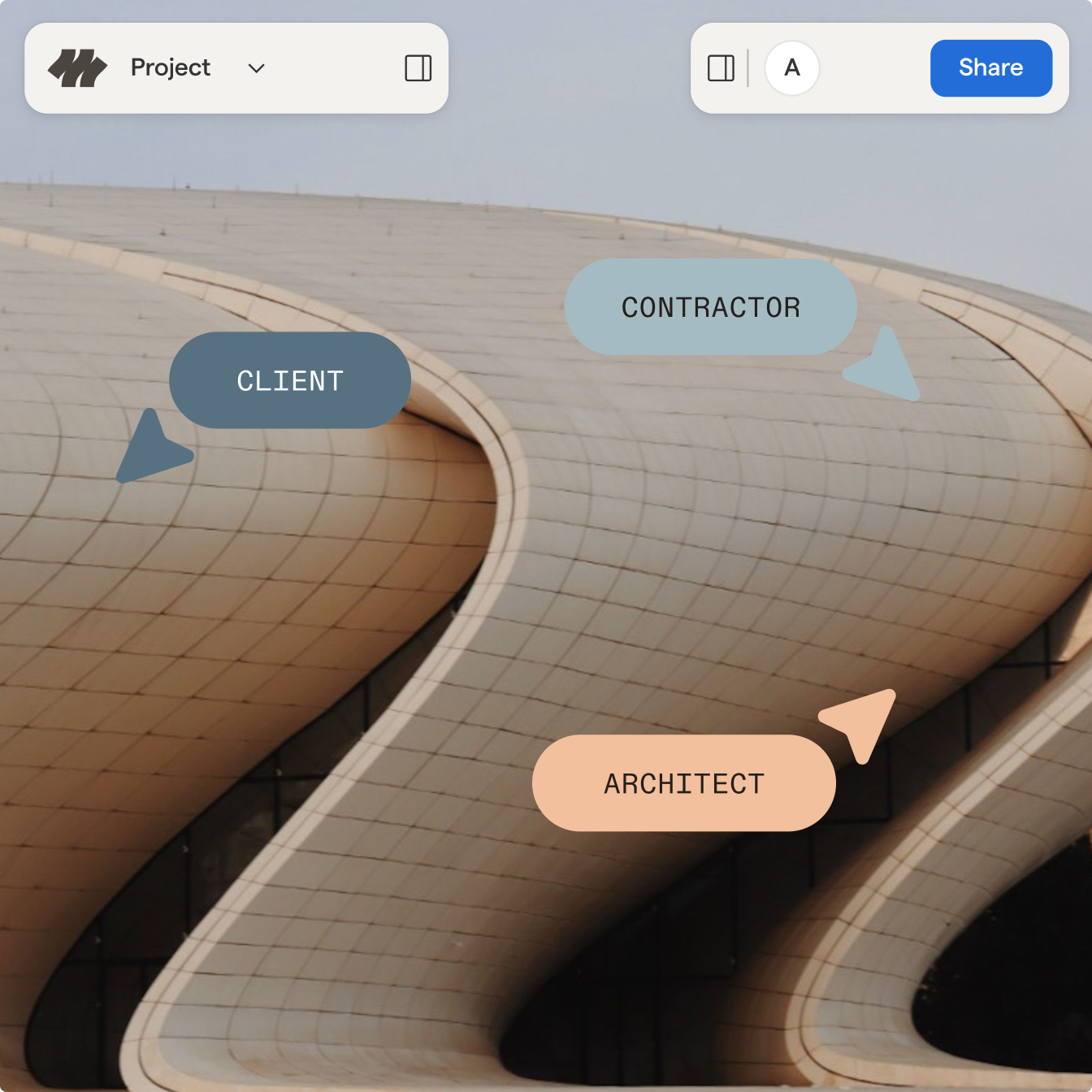
Collaboration here means three kinds of teamwork, not one. Person to person, the way you'd expect: many hands on one model, with conflicts handled gracefully. Two people reach for the same wall, an agent revises a room while someone's drawing next door, and the work stays coherent instead of the last save quietly clobbering everything before it. Person to agent: you hand off a task, an agent hands back the work, and you stay in the loop on what it did and why. And agent to agent: one agent's output becomes another's input, several of them coordinating on a job without a human relaying between them. All of it in the same model, at the same time. That's a genuinely new kind of teamwork, and it only works if the platform treats agents as first-class participants rather than visitors.
A team like that runs on trust, and trust runs on memory. Every action is logged: who did what, when, human or agent. You can always answer who decided this and why, trace a change back to its origin, and roll back when you need to. Nothing an agent does is invisible or irreversible. History isn't a compliance checkbox. It's what makes it safe to let agents act at all, and what lets a team move fast without losing the thread.
And collaboration only counts if everyone can actually get in. No installs, no licenses to count, nobody deciding who's worth a seat. The principal who wants to sketch over a plan, the client who needs to see the space, the consultant checking one detail: everyone opens a browser and works in the same live model. The people who shape a building finally get to touch it.
The what lives in the model. The why lives everywhere else, connected. The team, human and agent, works in one place, on one truth, with a full memory of how it got there. Everything in its right place.
.png)
Amar is the CEO and Co-Founder of Motif. He brings over 30 years of experience in software innovation in the AEC industry.